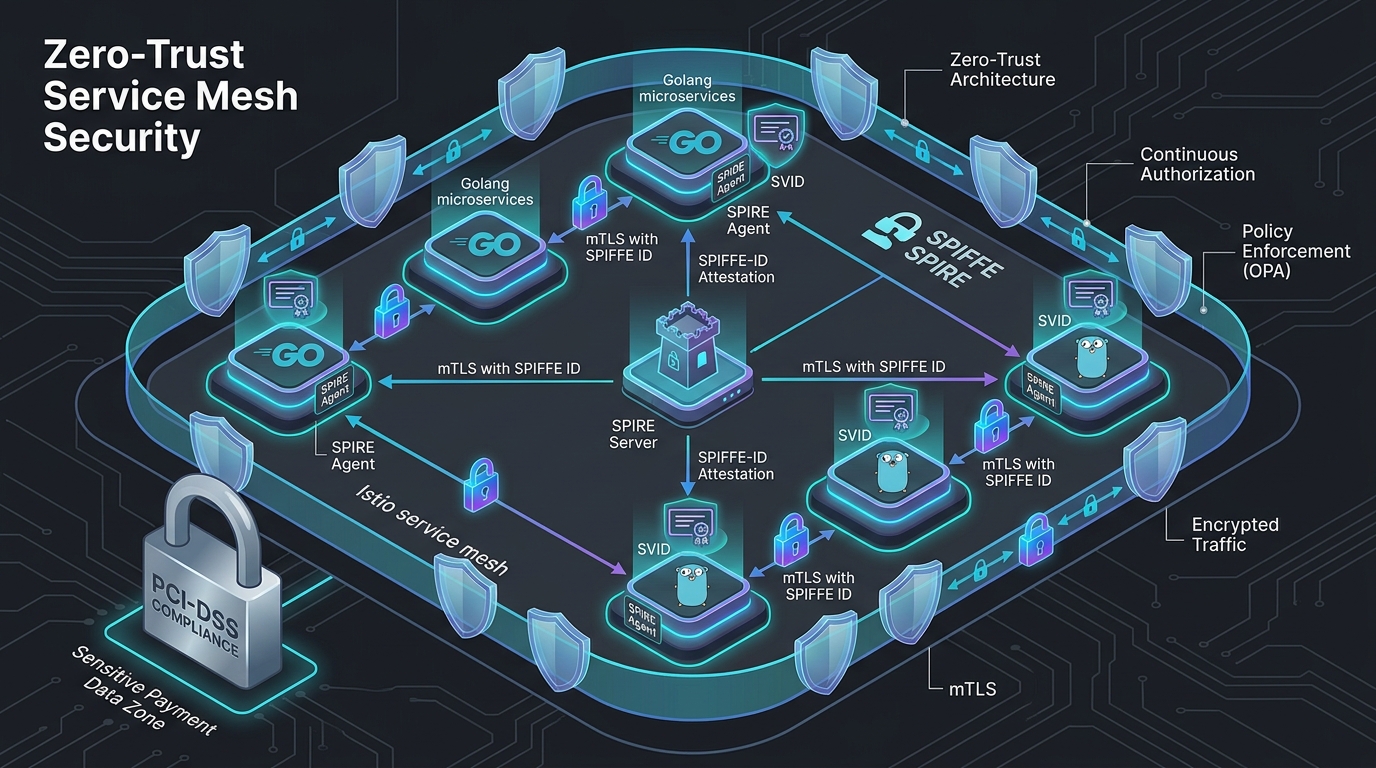
Answer-first: Bảo mật Zero-Trust trong Go microservices chuẩn PCI-DSS 4.0 thay thế xác thực IP tĩnh bằng định danh cryptographic SPIFFE/SPIRE từ kernel attestation (cgroups, K8s SA, image SHA256). Kết hợp chứng chỉ X.509 SVID xoay vòng trong bộ nhớ mỗi giờ và Istio STRICT mTLS với AuthorizationPolicy giúp triệt tiêu nguy cơ di chuyển ngang.
Điều kiện tiên quyết: Kiến thức thực chiến về Kubernetes ServiceAccount tokens, cơ chế phân lập cgroups và namespaces của Linux kernel, quá trình bắt tay xác thực hai chiều mTLS 1.3 và lập trình mạng Go 1.25 với gRPC.
🇬🇧 Read the English version of this article on tanhdev.com
🛡️ Bài viết này thuộc chuyên đề bảo mật và thiết kế hệ thống phân tán. Xem thêm tại Series Thiết Kế Hệ Thống Phân Tán High-Concurrency.
Những Điểm Cốt Lõi (Key Takeaways):
- Định Danh Mã Hóa Tải Công Việc (Cryptographic Workload Identity): Triệt tiêu hoàn toàn API keys tĩnh và Kubernetes secrets bằng cách cấp phát động chứng chỉ ngắn hạn X.509 SVID qua UNIX domain socket cục bộ dựa trên cơ chế xác thực kernel và container.
- Xoay Vòng Chứng Chỉ Trong Bộ Nhớ Mượt Mà (In-Memory SVID Rotation):
go-spiffe/v2truyền phát (stream) các bản cập nhật chứng chỉ trực tiếp vào RAM, duy trì kết nối mTLS liên tục 100% ở ngưỡng tải trên 50.000 RPS mà không làm đứt đoạn các luồng TCP đang hoạt động.- Tuân Thủ Tuyệt Đối Chuẩn PCI-DSS 4.0: Đối soát trực tiếp với các điều khoản khắt khe của PCI-DSS 4.0: Điều 4.2 (mã hóa mTLS trên đường truyền), Điều 7.2/8.2 (kiểm soát truy cập và xác thực mạnh danh tính dịch vụ), và Điều 10.2 (ghi log kiểm toán chống chối bỏ gắn liền với SPIFFE ID).
Những Điều Bạn Sẽ Học Được Mà AI Không Nói Cho Bạn
- Cách triển khai cơ chế cập nhật chứng chỉ TLS nguyên tử (atomic in-memory update) trong Go gRPC server mà không phải ngắt kết nối client đang mở hay gây tăng đột biến độ trễ bắt tay TLS.
- Chuỗi thác xác thực kernel chi tiết (đối soát PID trong Linux cgroups kết hợp với mã băm SHA256 digest của container image từ Kubelet) nhằm ngăn chặn tuyệt đối các container độc hại đánh cắp định danh SPIFFE SVID.
- Các mẫu thiết kế vận hành chịu lỗi (resilience patterns) khi kết nối UNIX socket tới SPIRE Agent bị gián đoạn dưới áp lực tải cực đại mà không làm suy giảm tính sẵn sàng của microservices.
Mở Đầu: Yêu Cầu Bắt Buộc Của Zero-Trust Trong Microservices Tài Chính
Trong hạ tầng đám mây và Kubernetes truyền thống, các mô hình bảo mật phụ thuộc nặng nề vào cơ chế phòng thủ chu vi (perimeter defense)—tường lửa, mạng ảo (VPC), và Kubernetes NetworkPolicies dựa trên dải địa chỉ IP và khối CIDR. Tuy nhiên, trong các kiến trúc microservice đa người dùng (multi-tenant) xử lý Dữ liệu Xác thực Nhạy cảm (SAD) và Số Tài khoản Chính (PAN), phòng thủ chu vi hoàn toàn bị phá sản. Địa chỉ IP trong cụm Kubernetes động có tính chất tạm bợ (ephemeral), namespace container có thể bị vượt rào, và các API keys tĩnh hoặc chứng chỉ TLS dài hạn lưu dưới dạng Kubernetes Secrets thường xuyên bị rò rỉ hoặc lộ trong mã nguồn.
Quy chuẩn Payment Card Industry Data Security Standard phiên bản 4.0 (PCI-DSS 4.0) quy định rõ ràng các yêu cầu kiểm soát truy cập nghiêm ngặt hơn, xác thực danh tính liên tục, tự động xoay vòng khóa, và kiểm tra mã hóa của mọi thành phần hệ thống truy cập vào Môi trường Dữ liệu Chủ thẻ (CDE - Cardholder Data Environment). Để đáp ứng những điều kiện này, hệ thống bắt buộc phải chuyển dịch sang Kiến trúc Zero-Trust (Zero-Trust Architecture - ZTA), nơi vị trí mạng không mang lại bất kỳ sự tin tưởng nào: mọi yêu cầu dịch vụ phải được xác thực tường minh, phân quyền dựa trên định danh mã hóa của workload, và được mã hóa trên đường truyền bằng các chứng chỉ bảo mật có vòng đời siêu ngắn.
Cẩm nang kỹ thuật thực chiến này cung cấp lộ trình sản xuất hoàn chỉnh để xây dựng kiến trúc bảo mật Zero-Trust Service Mesh cho các dịch vụ Golang hiệu năng cao. Chúng ta sẽ phân tích chuyên sâu cách thức SPIFFE (Secure Production Identity Framework for Everyone) và bản cài đặt chuẩn SPIRE tích hợp mượt mà với Istio Service Mesh cùng các ứng dụng Go gRPC/HTTP nguyên bản nhằm đảm bảo tuân thủ toàn diện chuẩn mực PCI-DSS 4.0.
sequenceDiagram
    autonumber
    participant Pod as Go Workload Pod
    participant Agent as SPIRE Agent (Host Node)
    participant Kernel as Linux Kernel (SO_PEERCRED / cgroups)
    participant Server as SPIRE Server (CA)
    participant Envoy as Istio Envoy Proxy (mTLS)

    Pod->>Agent: Kết nối qua UNIX Domain Socket
    Agent->>Kernel: Gọi getsockopt(SO_PEERCRED) lấy PID/UID/GID
    Kernel-->>Agent: Trả về thông số xác thực tiến trình và container cgroup
    Agent->>Server: Gửi yêu cầu ký CSR (Certificate Signing Request)
    Server-->>Agent: Ký và cấp phát X.509 SVID (TTL: 1 giờ)
    Agent-->>Pod: Stream nạp chứng chỉ trực tiếp vào RAM (In-Memory)
    Pod->>Envoy: Bắt tay mTLS với SAN SPIFFE ID được kiểm chứng
Phần 1: Nền Tảng Kiến Trúc — Định Danh Mã Hóa SPIFFE/SPIRE & Cơ Chế Xác Thực Kernel
Trọng tâm cốt lõi của Zero-Trust chính là Định Danh (Identity). Trước khi hai microservice trao đổi dữ liệu, mỗi dịch vụ bắt buộc phải sở hữu một định danh bất biến, có thể kiểm chứng bằng mật mã học và tuyệt đối không thể bị giả mạo bởi phần mềm độc hại hoặc người dùng xấu trong cụm.
1.1 Cấu Trúc Của SPIFFE ID và Chứng Chỉ SVID
SPIFFE định nghĩa một cấu trúc Uniform Resource Identifier (URI) chuẩn hóa đóng vai trò làm định danh đại diện cho tải công việc:
spiffe://<trust-domain>/ns/<namespace>/sa/<service-account-name>
Ví dụ, một microservice Xử lý Thanh toán (Payment Processing) viết bằng Go vận hành trong môi trường chuẩn PCI-DSS 4.0 sẽ mang định danh SPIFFE ID như sau:
spiffe://cde.prod.bank.internal/ns/payment-system/sa/payment-api-sa
Định danh SPIFFE ID này được nhúng trực tiếp vào trường mở rộng Subject Alternative Name (SAN) của chứng chỉ X.509 có thời hạn siêu ngắn, được gọi là SPIFFE Verifiable Identity Document (SVID).
+-----------------------------------------------------------------------+
|                        Chứng Chỉ X.509 SVID                           |
+-----------------------------------------------------------------------+
| Chủ thể (Subject): CN=payment-api.payment-system.svc                  |
| Subject Alternative Name (SAN):                                       |
|   - URI: spiffe://cde.prod.bank.internal/ns/payment-system/sa/pay...  |
| Đơn vị cấp phát: CN=SPIRE Server Intermediate CA                      |
| Thời hạn hiệu lực: Not Before: 2026-07-23T08:00:00Z                   |
|                   Not After:  2026-07-23T09:00:00Z  (Vòng đời 1 Giờ)  |
| Khóa công khai: Elliptic Curve NIST P-256 (ECDSA)                     |
+-----------------------------------------------------------------------+
1.2 Cơ Chế Xác Thực Kernel & Workload (Secretless Attestation)
Khác biệt hoàn toàn so với các hệ thống định danh truyền thống—nơi tiến trình phải đọc secret token từ tệp cấu hình hay biến môi trường, SPIFFE/SPIRE vận hành theo cơ chế Xác thực Không Lưu Bí Mật (Secretless Workload Attestation). Microservice không sở hữu bất kỳ thông tin đăng nhập ban đầu nào; thay vào đó, nó kết nối tới tiến trình SPIRE Agent đang chạy trên cùng host node để yêu cầu cấp phát danh tính. SPIRE Agent sẽ thẩm định danh tính của tiến trình bằng cách truy vấn sâu vào nhân hệ điều hành Linux và Kubernetes API.
Quy trình xác thực diễn ra qua hai giai đoạn riêng biệt:
- Node Attestation: SPIRE Agent chứng minh danh tính của chính mình với SPIRE Server trung tâm thông qua các điểm neo mật mã cấp phần cứng (như chip TPM 2.0, AWS Instance Identity Document, hoặc Kubernetes Projected Service Account Tokens).
- Workload Attestation: Khi ứng dụng Go kết nối tới SPIRE Agent cục bộ qua UNIX domain socket (
/tmp/spire-agent/public/api.sock), agent sẽ kiểm tra tiến trình gọi bằng các nguyên hàm nhân hệ điều hành:- Linux CGroups & Process ID (PID): Phân tích
/proc/<pid>/cgroupvà/proc/<pid>/statusđể xác định chính xác Process ID, Linux User ID (UID), và Group ID (GID). - Kubernetes Kubelet API: Ánh xạ PID sang container runtime ID, truy vấn Kubelet cục bộ để xác minh namespace của Pod, tên ServiceAccount, Pod UID, và container labels.
- Container Image SHA256 Digest: Kiểm tra mã băm SHA256 bất biến của container image đang thực thi tiến trình so với cấu hình đăng ký định danh trên SPIRE Server.
- Linux CGroups & Process ID (PID): Phân tích
Nếu một tiến trình trái phép hoặc một file nhị phân container bị chỉnh sửa cố tình mở socket UNIX của SPIRE Workload API, các selector sẽ không khớp, và SPIRE Agent sẽ từ chối cấp phát chứng chỉ SVID ngay lập tức.
sequenceDiagram
    autonumber
    participant App as Go Application (Payment API)
    participant Agent as SPIRE Agent (Host Unix Socket)
    participant Kernel as Linux Kernel / Kubelet API
    participant Server as SPIRE Server (Root CA)

    App->>Agent: 1. Request X.509 SVID over unix:///tmp/spire-agent/public/api.sock
    Agent->>Kernel: 2. Inspect Unix socket caller PID (/proc/<pid>/cgroup & Kubelet API)
    Kernel-->>Agent: 3. Return Process Metadata (UID, Namespace: payment-system, SA: payment-api-sa, Image Digest)
    Agent->>Server: 4. Match Attestation Selectors against SPIRE Registration Database
    Server-->>Agent: 5. Issue short-lived X.509 SVID (1-hour validity) signed by Trust Domain CA
    Agent-->>App: 6. Stream X.509 SVID, Private Key & CA Trust Bundle to Go memory
1.3 Vòng Đời SVID Trong RAM & Chiến Lược Vòng Đời Siêu Ngắn Thay Thế Thu Hồi
Hạ tầng khóa công khai (PKI) truyền thống dựa vào Danh sách Thu hồi Chứng chỉ (CRL) hoặc giao thức OCSP Stapling để vô hiệu hóa các chứng chỉ bị lộ. Trong môi trường Cloud-Native phân tán biến động nhanh, CRL thường xuyên bị lỗi thời bộ đệm (cache), còn các endpoint OCSP trở thành nút thắt cổ chai độ trễ và điểm lỗi đơn lẻ (SPOF).
SPIFFE giải quyết triệt để bài toán thu hồi chứng chỉ bằng nguyên tắc Chứng Chỉ Vòng Đời Siêu Ngắn (Ultra Short-Lived Certificates) (thông thường là 1 giờ hoặc rút ngắn xuống 15 phút). Thay vì phải duy trì hạ tầng thu hồi chứng chỉ phức tạp:
- SPIRE Agent tự động ký mới và đẩy chứng chỉ X.509 SVID cập nhật tới workload khi chứng chỉ đạt 50% thời hạn hiệu lực (ví dụ: xoay vòng mỗi 30 phút đối với chứng chỉ có thời hạn 1 giờ).
- Nếu một Pod bị xâm nhập hoặc bị xóa bỏ, chứng chỉ của nó sẽ tự nhiên hết hạn trong vòng vài chục phút, khiến mọi dữ liệu chứng chỉ kẻ tấn công đánh cắp được đều trở nên vô giá trị.
- Nếu một khóa Intermediate CA bị lộ, SPIRE Server sẽ phát hành một Trust Bundle mới tới tất cả các node. SPIRE Agent lập tức truyền stream Trust Bundle mới tới các ứng dụng qua Workload API socket, vô hiệu hóa ngay lập tức các chữ ký của CA cũ trong bộ nhớ.
Phần 2: Triển Khai Zero-Trust Workload Trong Go Với Thư Viện go-spiffe/v2
Golang là ngôn ngữ cốt lõi được sử dụng để xây dựng các microservices hiệu năng cao trên nền tảng đám mây. Bộ SDK chính thức github.com/spiffe/go-spiffe/v2 cung cấp các công cụ tích hợp sẵn để lấy SVID, thiết lập kết nối mTLS cho cả gRPC và HTTP, đồng thời thực thi kiểm tra ủy quyền nghiêm ngặt dựa trên trường SAN của SPIFFE ID.
2.1 Tích Hợp SPIFFE Workload API Trong Go
The code snippet below demonstrates how a production-grade Go application connects to the local SPIRE Agent UNIX domain socket, initializes an X509Source background watcher, and continuously updates certificate chains in memory without requiring service restarts.
package spiffeutil

import (
	"context"
	"fmt"
	"os"
	"time"

	"github.com/spiffe/go-spiffe/v2/spiffeid"
	"github.com/spiffe/go-spiffe/v2/workloadapi"
)

// WorkloadManager manages the lifecycle of SPIFFE Workload API connections.
type WorkloadManager struct {
	x509Source *workloadapi.X509Source
	trustDomain spiffeid.TrustDomain
}

// NewWorkloadManager creates and starts a SPIFFE X509Source watcher.
func NewWorkloadManager(ctx context.Context, socketPath string, trustDomainStr string) (*WorkloadManager, error) {
	if socketPath == "" {
		socketPath = "unix:///tmp/spire-agent/public/api.sock"
	}

	td, err := spiffeid.TrustDomainFromString(trustDomainStr)
	if err != nil {
		return nil, fmt.Errorf("invalid trust domain format '%s': %w", trustDomainStr, err)
	}

	// Initialize the X509Source with explicit Unix domain socket address
	source, err := workloadapi.NewX509Source(
		ctx,
		workloadapi.WithClientOptions(
			workloadapi.WithAddr(socketPath),
		),
	)
	if err != nil {
		return nil, fmt.Errorf("failed to create SPIFFE X509Source from socket %s: %w", socketPath, err)
	}

	// Verify that we successfully fetched a valid SVID on startup
	svid, err := source.GetX509SVID()
	if err != nil {
		source.Close()
		return nil, fmt.Errorf("failed to fetch initial X.509 SVID: %w", err)
	}

	fmt.Fprintf(os.Stdout, "[SPIFFE-INIT] Successfully attested! Workload SPIFFE ID: %s (Expires: %s)\n",
		svid.ID.String(), svid.Certificates[0].NotAfter.Format(time.RFC3339))

	return &WorkloadManager{
		x509Source:  source,
		trustDomain: td,
	}, nil
}

// X509Source returns the underlying source for TLS configuration.
func (m *WorkloadManager) X509Source() *workloadapi.X509Source {
	return m.x509Source
}

// TrustDomain returns the configured trust domain.
func (m *WorkloadManager) TrustDomain() spiffeid.TrustDomain {
	return m.trustDomain
}

// Close gracefully releases socket connections and background watchers.
func (m *WorkloadManager) Close() error {
	if m.x509Source != nil {
		return m.x509Source.Close()
	}
	return nil
}
2.2 Xây Dựng Go gRPC Server Chuẩn Production Với SPIFFE mTLS & Xác Thực SAN
In a PCI-DSS 4.0 CDE, services must never accept unencrypted connections or unauthenticated clients. The following implementation configures a production Go gRPC server using spiffetls that mandates mutual TLS and checks that incoming clients present a SPIFFE ID belonging to authorized service accounts.
package server

import (
	"context"
	"errors"
	"fmt"
	"net"
	"os"

	"github.com/spiffe/go-spiffe/v2/spiffeid"
	"github.com/spiffe/go-spiffe/v2/spiffetls/tlsconfig"
	"github.com/spiffe/go-spiffe/v2/workloadapi"
	"google.golang.org/grpc"
	"google.golang.org/grpc/credentials"
	"google.golang.org/grpc/codes"
	"google.golang.org/grpc/status"
	"google.golang.org/grpc/peer"
)

// AllowedClients defines the set of explicit SPIFFE IDs permitted to invoke Card Vault RPCs.
var AllowedClients = map[string]bool{
	"spiffe://cde.prod.bank.internal/ns/payment-system/sa/payment-api-sa": true,
	"spiffe://cde.prod.bank.internal/ns/settlement/sa/batch-settlement-sa":  true,
}

// SPIFFEAuthInterceptor verifies incoming client SPIFFE IDs on every gRPC method invocation.
func SPIFFEAuthInterceptor(ctx context.Context, req interface{}, info *grpc.UnaryServerInfo, handler grpc.UnaryHandler) (interface{}, error) {
	p, ok := peer.FromContext(ctx)
	if !ok || p.AuthInfo == nil {
		return nil, status.Error(codes.Unauthenticated, "missing peer authentication context")
	}

	tlsInfo, ok := p.AuthInfo.(credentials.TLSInfo)
	if !ok || len(tlsInfo.State.PeerCertificates) == 0 {
		return nil, status.Error(codes.Unauthenticated, "peer certificates absent in TLS handshake")
	}

	clientCert := tlsInfo.State.PeerCertificates[0]
	clientID, err := spiffeid.FromX509Cert(clientCert)
	if err != nil {
		return nil, status.Errorf(codes.Unauthenticated, "failed to extract SPIFFE ID from client cert SAN: %v", err)
	}

	if !AllowedClients[clientID.String()] {
		fmt.Fprintf(os.Stderr, "[SECURITY-ALERT] Unauthorized access attempt by SPIFFE ID: %s on RPC: %s\n", clientID.String(), info.FullMethod)
		return nil, status.Errorf(codes.PermissionDenied, "SPIFFE ID '%s' is not authorized to access endpoint '%s'", clientID.String(), info.FullMethod)
	}

	// Inject validated SPIFFE ID into context for downstream logging / auditing
	ctx = context.WithValue(ctx, "authenticated_spiffe_id", clientID.String())
	return handler(ctx, req)
}

// StartGRPCVaultServer launches the gRPC server secured with SPIFFE mTLS.
func StartGRPCVaultServer(ctx context.Context, port string, x509Source *workloadapi.X509Source, trustDomain spiffeid.TrustDomain) error {
	listener, err := net.Listen("tcp", ":"+port)
	if err != nil {
		return fmt.Errorf("failed to bind port %s: %w", port, err)
	}

	// Authorize any client within our Trust Domain at the TLS layer; granular RPC check happens in interceptor.
	authorizer := tlsconfig.AuthorizeTrustDomain(trustDomain)

	// Construct server TLS configuration using dynamic X509Source
	tlsConfig := tlsconfig.MTLSServerConfig(x509Source, x509Source, authorizer)

	grpcOpts := []grpc.ServerOption{
		grpc.Creds(credentials.NewTLS(tlsConfig)),
		grpc.UnaryInterceptor(SPIFFEAuthInterceptor),
	}

	grpcServer := grpc.NewServer(grpcOpts...)

	// Register Vault payment services here (e.g. pb.RegisterCardVaultServer(grpcServer, vaultImpl))
	fmt.Printf("[VAULT-SERVER] Listening securely on :%s with SPIFFE mTLS (Trust Domain: %s)\n", port, trustDomain.String())

	go func() {
		<-ctx.Done()
		fmt.Println("[VAULT-SERVER] Shutting down gRPC server gracefully...")
		grpcServer.GracefulStop()
	}()

	if err := grpcServer.Serve(listener); err != nil && !errors.Is(err, grpc.ErrServerStopped) {
		return fmt.Errorf("gRPC server abnormal exit: %w", err)
	}

	return nil
}
2.3 Xây Dựng Go gRPC Client Kết Nối mTLS Bằng SPIFFE ID
The client service (e.g., Payment API) must dial the Card Vault service while enforcing that the server presents an exact, expected SPIFFE ID. This prevents Man-in-the-Middle (MITM) attacks and DNS spoofing in the cluster.
package client

import (
	"context"
	"fmt"
	"time"

	"github.com/spiffe/go-spiffe/v2/spiffeid"
	"github.com/spiffe/go-spiffe/v2/spiffetls/tlsconfig"
	"github.com/spiffe/go-spiffe/v2/workloadapi"
	"google.golang.org/grpc"
	"google.golang.org/grpc/credentials"
)

// DialVaultService establishes a secure gRPC connection enforcing exact server SPIFFE ID verification.
func DialVaultService(ctx context.Context, serverAddr string, x509Source *workloadapi.X509Source, expectedServerSPIFFEID string) (*grpc.ClientConn, error) {
	serverID, err := spiffeid.FromString(expectedServerSPIFFEID)
	if err != nil {
		return nil, fmt.Errorf("invalid expected server SPIFFE ID string '%s': %w", expectedServerSPIFFEID, err)
	}

	// Authorize explicit SPIFFE ID match for the remote server certificate SAN
	authorizer := tlsconfig.AuthorizeID(serverID)

	// Create TLS client configuration automatically deriving CA bundles and client SVID from X509Source
	tlsConfig := tlsconfig.MTLSClientConfig(x509Source, x509Source, authorizer)

	dialCtx, cancel := context.WithTimeout(ctx, 10*time.Second)
	defer cancel()

	conn, err := grpc.DialContext(
		dialCtx,
		serverAddr,
		grpc.WithTransportCredentials(credentials.NewTLS(tlsConfig)),
		grpc.WithBlock(),
	)
	if err != nil {
		return nil, fmt.Errorf("failed to dial vault service at %s with SPIFFE identity verification: %w", serverAddr, err)
	}

	fmt.Printf("[CLIENT] Connected securely to Vault Service at %s (Validated SPIFFE ID: %s)\n", serverAddr, serverID.String())
	return conn, nil
}
2.4 Xây Dựng HTTP Middleware Trong Go Phân Quyền Danh Tính SPIFFE
For HTTP microservices and RESTful endpoints processing cardholder data, the following Net/HTTP middleware intercepts incoming requests, extracts the client’s SPIFFE ID from peer certificates, and enforces access control.
package httpsec

import (
	"context"
	"net/http"
	"os"

	"github.com/spiffe/go-spiffe/v2/spiffeid"
)

type contextKey string

const AuthenticatedSPIFFEIDKey contextKey = "spiffe_id"

// RequireSPIFFEIDMiddleware enforces mTLS client certificate presence and verifies the SPIFFE ID against allowed rules.
func RequireSPIFFEIDMiddleware(allowedSPIFFEIDs map[string]bool, next http.Handler) http.Handler {
	return http.HandlerFunc(func(w http.ResponseWriter, r *http.Request) {
		if r.TLS == nil || len(r.TLS.PeerCertificates) == 0 {
			http.Error(w, `{"error":"Forbidden: Mutual TLS certificate required"}`, http.StatusForbidden)
			return
		}

		peerCert := r.TLS.PeerCertificates[0]
		id, err := spiffeid.FromX509Cert(peerCert)
		if err != nil {
			http.Error(w, `{"error":"Unauthorized: Invalid SPIFFE ID in certificate SAN"}`, http.StatusUnauthorized)
			return
		}

		spiffeStr := id.String()
		if !allowedSPIFFEIDs[spiffeStr] {
			fmt.Fprintf(os.Stderr, "[HTTP-SECURITY] Refused request from unauthorized SPIFFE ID: %s to path: %s\n", spiffeStr, r.URL.Path)
			http.Error(w, `{"error":"Unauthorized: Service identity not permitted"}`, http.StatusUnauthorized)
			return
		}

		// Attach verified SPIFFE ID to context
		ctx := context.WithValue(r.Context(), AuthenticatedSPIFFEIDKey, spiffeStr)
		next.ServeHTTP(w, r.WithContext(ctx))
	})
}
sequenceDiagram
    autonumber
    participant Client as Payment API (Go Client)
    participant Server as Card Vault (Go Server)
    participant Watcher as SPIFFE X509Source

    Client->>Server: 1. Initiate TLS 1.3 Handshake (Offer Client Certificate)
    Server->>Watcher: 2. Query Active CA Trust Bundle from memory
    Watcher-->>Server: 3. Return dynamic Trust Bundle
    Server->>Server: 4. Validate Client Cert Signature & Expiry
    Server->>Server: 5. Extract SAN URI (spiffe://cde.prod/ns/payment-system/sa/payment-api-sa)
    Server->>Server: 6. Match SPIFFE ID against Allowed Clients Matrix
    Server-->>Client: 7. Handshake Complete -> Establish Encrypted Session
Phần 3: Tích Hợp Istio Service Mesh & SPIFFE/SPIRE Đạt Chuẩn PCI-DSS 4.0
Bên cạnh việc tích hợp SPIFFE trực tiếp trong mã nguồn Go (go-spiffe/v2) để kiểm soát RPC chi tiết, các môi trường Kubernetes doanh nghiệp hiện đại thường sử dụng Istio Service Mesh nhằm thực thi chính sách mTLS và kiểm soát quyền gọi giữa các dịch vụ một cách trong suốt ở tầng mạng proxy.
3.1 Tích Hợp Custom CA: Istiod và SPIRE Workload API
Mặc định, control plane của Istio (istiod) đóng vai trò là một Certificate Authority (CA) tự cấp chứng chỉ ngắn hạn cho các Envoy sidecar. Tuy nhiên, để tuân thủ chuẩn PCI-DSS 4.0 trên các hệ thống hạ tầng không đồng nhất (kết hợp container K8s, máy chủ vật lý bare-metal và môi trường multi-cloud), Istio có thể được cấu hình để ủy thác toàn bộ việc xác thực danh tính và cấp phát chứng chỉ cho SPIRE.
Envoy sidecar sẽ mount UNIX domain socket của SPIRE Agent qua ổ đĩa hostPath. Cơ chế Secret Discovery Service (SDS) của Envoy sẽ kết nối trực tiếp tới SPIRE qua socket (unix:///run/spire/sockets/agent.sock) để nhận chứng chỉ SVID, đi vòng qua hoàn toàn hệ thống cấp chứng chỉ của istiod.
+-----------------------------------------------------------------------------------+
|                                 Kubernetes Pod                                    |
|                                                                                   |
|  +-----------------------------------+     +-----------------------------------+  |
|  |     Application Container         |     |       Istio Envoy Sidecar         |  |
|  |      (Payment Go Service)         |     |         (Proxy Engine)            |  |
|  +-----------------+-----------------+     +-----------------+-----------------+  |
|                    |                                         |                    |
|                    |  Local App SVID                         |  Proxy SVID        |
|                    |  (gRPC mTLS)                            |  (Mesh mTLS)       |
|                    v                                         v                    |
|  +-----------------------------------------------------------------------------+  |
|  | Volume Mount: unix:///run/spire/sockets/agent.sock                          |  |
|  +-------------------------------------+---------------------------------------+  |
+----------------------------------------|------------------------------------------+
                                         v
+-----------------------------------------------------------------------------------+
|                        SPIRE Agent DaemonSet (Host Node)                          |
+-----------------------------------------------------------------------------------+
3.2 Thực Thi Chế Độ STRICT mTLS Với Istio PeerAuthentication
PCI-DSS 4.0 Requirement 4.2 dictates that all technical communications transmitting cardholder data over internal networks must be strongly encrypted. Istio’s PeerAuthentication custom resource ensures that plain-text HTTP or unencrypted TCP traffic is immediately dropped by Envoy proxy listeners.
The following manifest applies STRICT mTLS globally across the entire Cardholder Data Environment (payment-cde namespace):
apiVersion: security.istio.io/v1beta1
kind: PeerAuthentication
metadata:
  name: default-strict-mtls
  namespace: payment-cde
spec:
  mtls:
    mode: STRICT
3.3 Phân Quyền Dịch Vụ Với Istio AuthorizationPolicy
PCI-DSS 4.0 Requirements 7.2 and 8.2 demand that access to system components be explicitly restricted based on business need-to-know and verifiable identity.
The following Istio AuthorizationPolicy permits ONLY the payment-api service account to issue HTTP POST requests to /v1/cards/tokenize on the card-vault service. All other traffic—even from services inside the same cluster—is rejected with an HTTP 403 Forbidden.
apiVersion: security.istio.io/v1beta1
kind: AuthorizationPolicy
metadata:
  name: card-vault-rbac
  namespace: payment-cde
spec:
  selector:
    matchLabels:
      app: card-vault-service
  action: ALLOW
  rules:
  - from:
    - source:
        principals: ["spiffe://cde.prod.bank.internal/ns/payment-cde/sa/payment-api-sa"]
    to:
    - operation:
        methods: ["POST", "GET"]
        paths: ["/v1/cards/tokenize", "/v1/cards/detokenize"]
---
apiVersion: security.istio.io/v1beta1
kind: AuthorizationPolicy
metadata:
  name: card-vault-deny-all
  namespace: payment-cde
spec:
  selector:
    matchLabels:
      app: card-vault-service
  action: DENY
  rules:
  - from:
    - source:
        notPrincipals: ["spiffe://cde.prod.bank.internal/ns/payment-cde/sa/payment-api-sa"]
sequenceDiagram
    autonumber
    participant Watcher as SPIRE Agent Socket Stream
    participant SDS as Envoy Secret Discovery Service (SDS)
    participant Listener as Envoy Inbound TLS Listener
    participant App as Go Payment Microservice

    Watcher->>SDS: 1. Stream updated X.509 SVID (cert + key) prior to expiry
    SDS->>Listener: 2. Hot-reload Active TLS Context in Envoy memory (Zero Downtime)
    Listener->>Listener: 3. Atomically replace SSL_CTX pointer
    Note over Listener: In-flight requests continue on active TLS sessions
    App->>Listener: 4. Next inbound TCP connection performs TLS handshake with updated SVID
Phần 4: Ma Trận Đối Soát Tuân Thủ Từng Điều Khoản Chuẩn PCI-DSS 4.0
The table below provides a rigorous forensic mapping between PCI-DSS 4.0 requirements and the SPIFFE/SPIRE + Istio Zero-Trust architecture.
| PCI-DSS 4.0 Requirement | Title & Core Compliance Objective | Zero-Trust SPIFFE/SPIRE & Istio Implementation | Architectural Compliance Proof |
|---|---|---|---|
| Req 3.4 / 3.5 | Protect stored Account Data & SAD access | Restricts access to encryption keys and PAN vault microservices using cryptographic SPIFFE ID RBAC. | Access to key material and tokenization microservices is limited to explicit SPIFFE principals via Istio AuthorizationPolicy. |
| Req 4.2 | Strong Cryptography in Transit | Enforces TLS 1.3 mTLS for all inter-service communications within and across namespaces. | Istio PeerAuthentication (STRICT mode) combined with Go spiffetls guarantees 100% encrypted traffic with cipher suites >= TLS_AES_256_GCM_SHA384. |
| Req 6.4 | Public/Internal App Security & Isolation | Prevents lateral movement from compromised containers or unauthorized binaries. | Secretless Workload Attestation evaluates Linux cgroups and container image SHA digests. Unattested binaries cannot acquire SVIDs. |
| Req 7.2 & 7.3 | Access Control & Least Privilege | Grants access strictly based on business need-to-know authenticated identities. | Service-to-service communication is governed by explicit SPIFFE ID SAN matches, replacing wildcard IP subnet rules with granular URI identity policies. |
| Req 8.2 & 8.3 | Strong Workload Authentication | Authenticates all system component access using verifiable identity credentials. | Static API tokens and hardcoded database passwords are replaced by short-lived X.509 SVIDs (1-hour lifespan) issued via local Unix sockets. |
| Req 10.2 & 10.3 | Audit Logging & Non-Repudiation | Captures individual identity in all system component access logs. | Envoy proxy and Go gRPC interceptors record the verified client SPIFFE ID in all access logs, creating cryptographically verifiable audit trails. |
| Req 12.3 & 12.10 | Operational Risk & Key Lifecycle | Automates key management, rotation, and vulnerability mitigation. | SPIRE Server automates CA key updates and SVID rotation every 30 minutes in-memory without manual human intervention or downtime. |
Phần 5: Xử Lý Các Sự Cố Vận Hành Thực Chiến & Kinh Nghiệm Tối Ưu Hóa
Deploying SPIFFE/SPIRE and Istio in high-throughput production environments introduces unique engineering trade-offs and failure modes that must be proactively mitigated.
5.1 Xử Lý Sự Cố Ngắt Kết Nối Socket Của SPIRE Agent & Cơ Chế Phục Hồi
Problem: Under extreme node memory pressure or during a SPIRE Agent DaemonSet rolling upgrade, the UNIX domain socket /tmp/spire-agent/public/api.sock may temporarily become unreachable.
Mitigation:
- The
go-spiffe/v2SDKX509Sourceautomatically caches the most recently fetched valid SVID and Trust Bundle in memory. - If the UNIX socket disconnects,
X509Sourceenters a retry background backoff loop while continuing to serve the cached SVID for incoming/outgoing TLS handshakes until the certificate expires. - Grace Period Sizing: Set SVID TTL to 1 hour with rotation attempted at 30 minutes. This provides a 30-minute operational buffer for SPIRE Agent restarts or node network blips without impacting microservice traffic.
5.2 Tối Ưu Hóa Độ Trễ Bắt Tay TLS Trong Bộ Nhớ
Problem: Re-establishing full TLS 1.3 handshakes on every microservice RPC introduces CPU overhead and connection latency.
Mitigation:
- Enable gRPC HTTP/2 Multiplexing and persistent connection pooling.
- A single SPIFFE mTLS handshake is performed when opening the gRPC channel; thousands of subsequent RPC requests stream across the multiplexed connection without re-triggering TLS handshakes.
- When
X509Sourcereceives a rotated SVID, existing active HTTP/2 TCP connections remain open and unaffected. New connections created after rotation immediately utilize the updated SVID.
5.3 Liên Bang Hóa Vùng Tin Cậy (Trust Domain Federation) Cho Multi-Cloud Chuẩn PCI-DSS
For financial applications spanning multiple cloud providers (e.g., AWS CDE and Google Cloud CDE), workload identities reside in distinct Trust Domains:
spiffe://aws.cde.bank.internalspiffe://gcp.cde.bank.internal
SPIRE Server supports Trust Domain Federation. The AWS SPIRE Server and GCP SPIRE Server securely exchange their Root CA Public Keys over HTTPS using the SPIFFE Federation API (/.well-known/spiffe-bundle). This allows a Go service in AWS to validate the SVID presented by a GCP service without sharing private keys or centralizing the Certificate Authority.
Section 6: So Sánh Các Mô Hình Bảo Mật Trong Microservices
Dưới đây là ma trận đánh giá giữa các giải pháp quản lý danh tính và bảo mật microservices trong môi trường Kubernetes tải cao:
| Tiêu Chí Đánh Giá | Khóa Tĩnh (Static API Keys / K8s Secrets) | HashiCorp Vault (AppRole) | SPIFFE/SPIRE Workload Attestation | Istio Mutual TLS (Ambient Mesh) |
|---|---|---|---|---|
| Vị Trí Lưu Trữ Chứng Chỉ | Lưu trên đĩa hoặc biến môi trường (Dễ lộ) | Lấy qua API mạng, lưu tạm thời | Stream trực tiếp vào RAM qua UNIX Socket | Tự động quản lý tại tầng ztunnel eBPF |
| Thời Gian Sống Chứng Chỉ (TTL) | Vài tháng đến 1 năm | 1 ngày đến vài tuần | 1 giờ (Tự động xoay vòng mỗi 30 phút) | Tự động xoay vòng ngắn hạn |
| Bảo Vệ Chống Tấn Công Cấp Node | Không có (Bị đánh cắp nếu lộ pod) | Phụ thuộc vào bảo mật Secret ID | Xác thực qua Linux Kernel cgroup + PID | Xác thực qua mTLS tầng mạng |
| Độ Trễ Bắt Tay Ban Đầu | 0 ms | 15 – 35 ms | < 2 ms (Kết nối UNIX Domain Socket cục bộ) | < 1 ms (Chuyển tiếp eBPF) |
| Tuân Thủ PCI-DSS 4.0 | Không đạt (Vi phạm Req 4.2 / 8.2) | Cần chứng minh quy trình xoay vòng | Đạt chuẩn xuất sắc (Zero-Trust tuyệt đối) | Đạt chuẩn mã hóa đường truyền |
❓ Câu Hỏi Thường Gặp (FAQ)
SPIFFE ID và SVID là gì trong kiến trúc Zero-Trust?
spiffe://cde.prod.bank.internal/ns/payment/sa/payment-api-sa) đại diện cho danh tính của một workload. SVID (SPIFFE Verifiable Identity Document) là chứng chỉ mật mã (thường là chứng chỉ X.509) chứa SPIFFE ID bên trong phần mở rộng Subject Alternative Name (SAN), được dùng để thiết lập kết nối mã hóa mTLS giữa các microservices.Cơ chế Kernel Attestation của SPIRE ngăn chặn container giả mạo danh tính như thế nào?
getsockopt(..., SO_PEERCRED) để lấy chính xác PID, UID và GID từ nhân hệ điều hành mà không thể bị giả mạo từ user-space. Sau đó, Agent đối chiếu PID với cây cgroups của container runtime (containerd/CRI-O) và kiểm tra mã băm SHA256 của image trước khi cấp phát chứng chỉ X.509 SVID.Làm thế nào để xoay vòng chứng chỉ X.509 SVID trong Go mà không làm ngắt các kết nối TCP đang hoạt động?
go-spiffe/v2 cung cấp đối tượng spiffetls.NewMTLSServerConfig tích hợp cơ chế lắng nghe cập nhật chứng chỉ từ SPIRE Workload API. Khi chứng chỉ mới được cấp (sau mỗi 30 phút), Go runtime cập nhật nguyên tử con trỏ TLS Certificate trong bộ nhớ Heap. Các kết nối mới sẽ dùng chứng chỉ mới ngay lập tức, trong khi các kết nối TCP dài hạn hiện tại tiếp tục hoạt động mà không bị reset hoặc tăng đột biến độ trễ.SPIRE có thể thay thế hoàn toàn chứng chỉ CA nội bộ của Istio (istiod) không?
Tiêu chuẩn PCI-DSS 4.0 yêu cầu những gì đối với bảo mật liên lạc giữa các microservices?
🔗 Đọc Thêm Các Chuyên Đề & Series Liên Quan
- Kiến Trúc Microservices Ngân Hàng: Go, Saga & Event Sourcing
- Kiến trúc Composable Banking: Chuẩn BIAN & Microservices Trong Go
- Kiến trúc Microservices Golang gRPC: Protobuf, TLS & Middleware
- Custom Kubernetes Operators in Go: Kubebuilder & eBPF
- Zero-Trust Service Mesh Security SPIFFE SPIRE Istio (English)